
Robots in the wild: how robotics is used to study animals
Advances in robotics and computing power allow engineers to create robots so realistic that animals react to them as if they were real. The degree of realism depends on the animals being studied. Sometimes a robot needs to look right, sometimes it needs to smell right, and sometimes it just needs to move. Robots can tell researchers a lot about how animals interact in the natural world . In the article we will look at 4 biomimetic (animal-like) robots that are already being used by scientists to study and sometimes control the social life of real animals.
Robo bees in a hive
Honey bees perform a “waggle dance” as they return to the hive. This is how the worker signals the location of the food source. She runs along a certain route near the entrance to the hive and vibrates her wings and body as she does so. This “dance” has been known for more than 60 years. However, researchers still don’t know exactly how other bees decode this message. They decided to find out with the help of Robobee.
Tim Landgraf, a roboticist at the Free University of Berlin, has made a life-size replica of a bee . More precisely, it’s a fuzzy bee-shaped plastic ball with one wing. It was connected to a mechanical drive, which changed the direction of movement and vibration of the dummy. The robo-bee was placed in a hive, and later it was discovered that this could actually guide real bees to a food source.
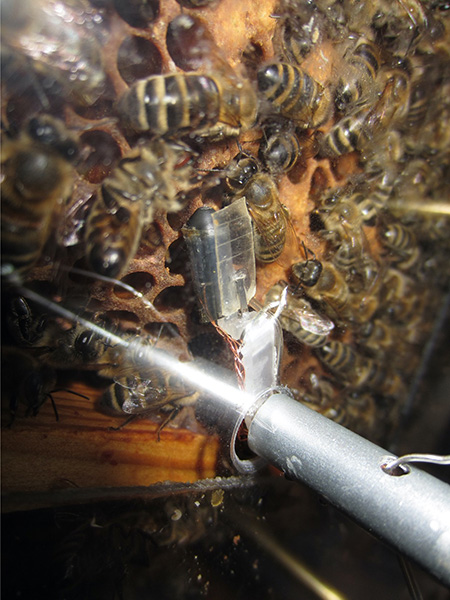
However, Robobee’s success cannot be called stable. “Sometimes the bees would follow him for a few seconds. But sometimes it took days, and we couldn’t tell why,” says Landgraf. This led scientists to believe that there are other factors in dance communication besides movements and vibrations. They are now developing an upgraded Robobee with a more realistic smell and a more reliable wing vibration mechanism.
Robotic falcon on the hunt
According to the selfish flock theory, when a falcon attacks pigeons, each bird tries to be in the center of the flock so that the predator can take some other unfortunate pigeon. But this idea is not easy to test. Each falcon strikes differently: a little higher than the others, or at a different angle. And all this variability can affect the pigeons’ reactions.
Daniel Sankey, a behavioral ecologist at the University of Exeter (UK), decided to test the theory using a robot . In his opinion, this is a controlled way of conducting research. The robotic falcon had to be exactly 20 meters behind when the pigeons were released. In previous attempts, a trained falcon was used, and it completely destroyed the flock. In this regard, the robotic bird is much safer. It looks realistic except for the propeller. The falcon repeatedly attacked the pigeons and tracked each bird’s position using GPS.
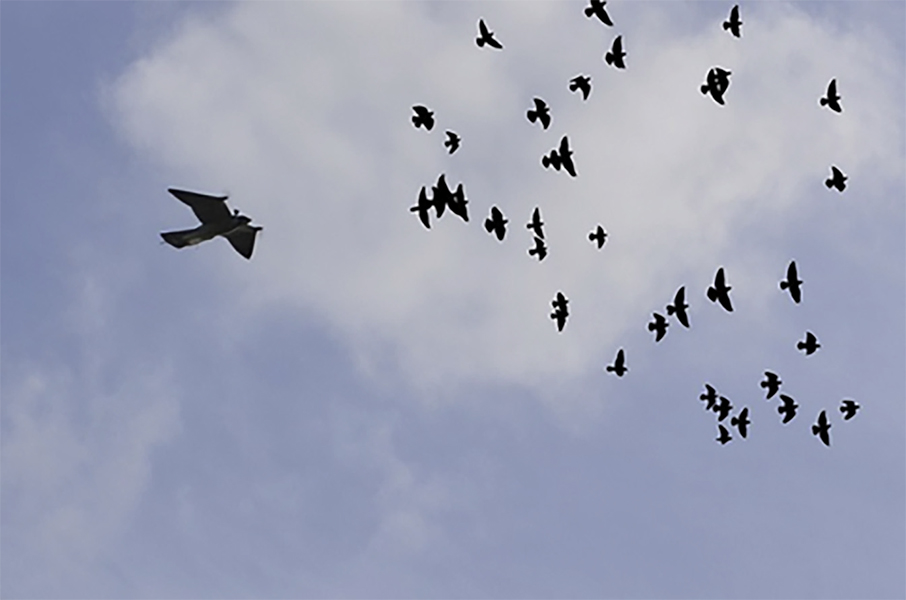
This study disproved the selfish pack theory. Pigeons moved to the center of the flock when attacked by a falcon no more often than in normal times. Scientists have suggested that a flock of pigeons may be cooperative rather than selfish, that is, individuals focus on each other and are saved by the group.
Robot fish in a school
Which fish most often lead a school? Most studies show that large fish have the greatest influence on where a school goes. This was verified using a robotic fish.
Jens Krause, an animal behaviorist at the University of Berlin. Humboldt, together with his colleagues, developed Robofish , a 3D printed replica of a guppy mounted on a pedestal. It is driven by a device under the aquarium. Two video cameras connected to a computer allow Robofish to react to the movements of other fish in real time.
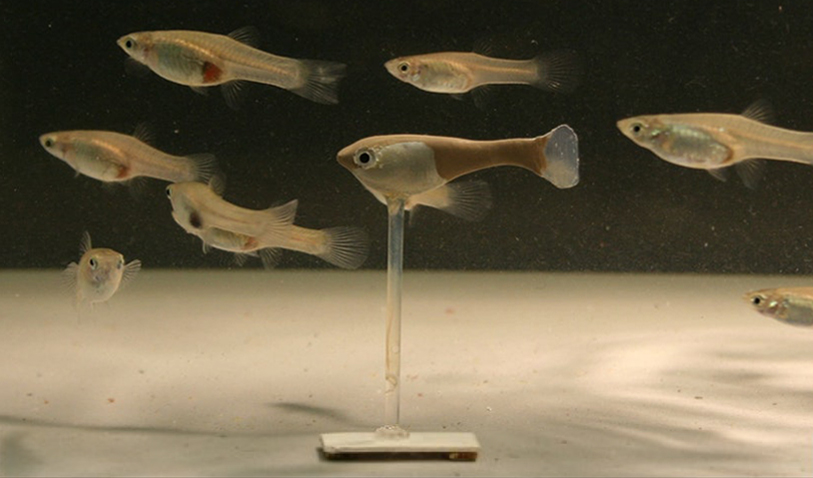
It turned out that as long as the model had eyes and a vaguely realistic color pattern, the guppies behaved towards it the same way as towards any other fish. The researchers then replaced it with a larger model to study the effect of individual size on school behavior. As it turns out, guppies are more willing to follow larger fish. The team also used Robofish to study how the swimming speed of individuals affected the behavior of the entire group.
In addition, the robot helped to learn that guppies respect personal space. When Robofish got too close to the individuals, they retreated. When it was tuned to not violate boundaries, the new “socially competent” Robofish was much better at attracting followers.
Robot termites in a swarm
In previous studies, robots penetrated real groups of animals and provoked them to respond. But there is another way to use robots to study animal behavior: program a swarm of robots to act according to the rules that real animals adhere to, and see if the result mimics the animals’ behavior.
This is exactly the approach taken by Justin Werfel, a researcher of collective behavior at Harvard. He wanted to understand how termites build such complex termite mounds with many branches. He decided to study how individuals carrying soil from a termite mound choose a place to dump it. This simple solution determines the complex shape of the entrance to the termite mound.
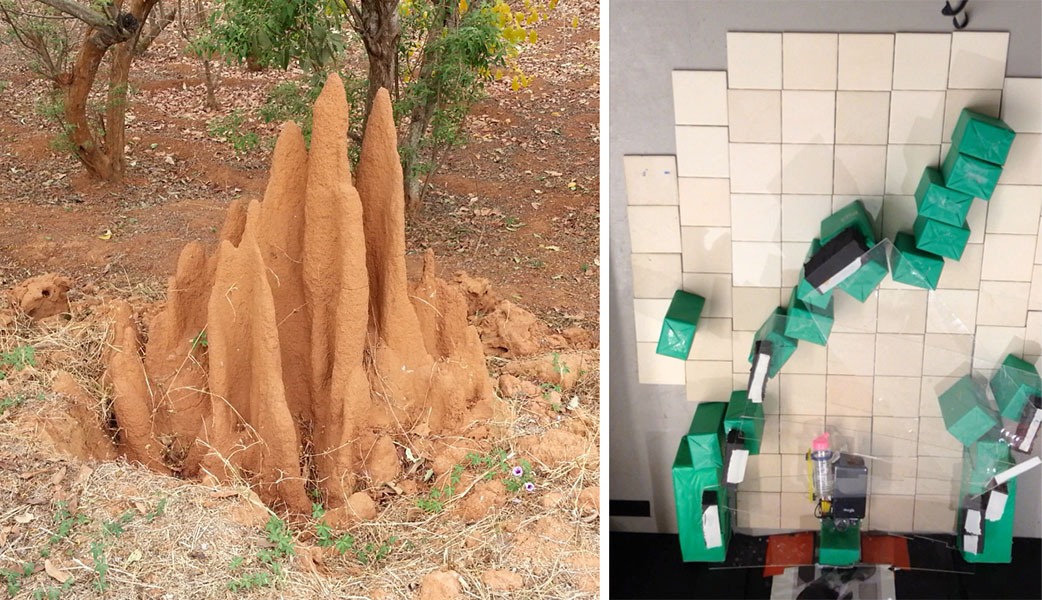
Scientists hypothesized that the insects were dumping soil at a point where the high internal humidity of the termite mound gave way to drier air at the surface. This is a marker to determine the boundary of their home. But the researchers didn’t know whether the termites’ behavior depended on other factors.
So they created a swarm of robotic termites . Since they didn’t have to interact with real insects, they didn’t have to look realistic. Instead, the robots were brick-sized carts that could carry and drop colored blocks onto a flat surface. Each termite robot had a humidity sensor and was programmed to carry blocks when humidity was high and drop them when humidity dropped.
The swarm of robots eventually dropped their blocks into a 2D version of the entrance to a real termite mound. The robots even closed the hole on windy days, just like real termites do. The experiment, of course, does not prove that termites actually use the rule of humidity to build their mounds, but it is quite enough to complete the task.
He who became the CEO of India’s leading software company at the age of 19

Outstanding Indian tech CEOs in the US

Here are useful Eye Care Tips for those who look at the computer screen for so long
About The Author
